
How to Identify Vintage Lamps: Base, Socket, and Shade Clues
Identifying vintage lamps requires examining the base material and construction, socket hardware and wiring, shade attachment method, and any maker marks. This guide shows which details matter most and how to photograph each component for accurate identification.
How to Identify Vintage Lamps: Base, Socket, and Shade Clues
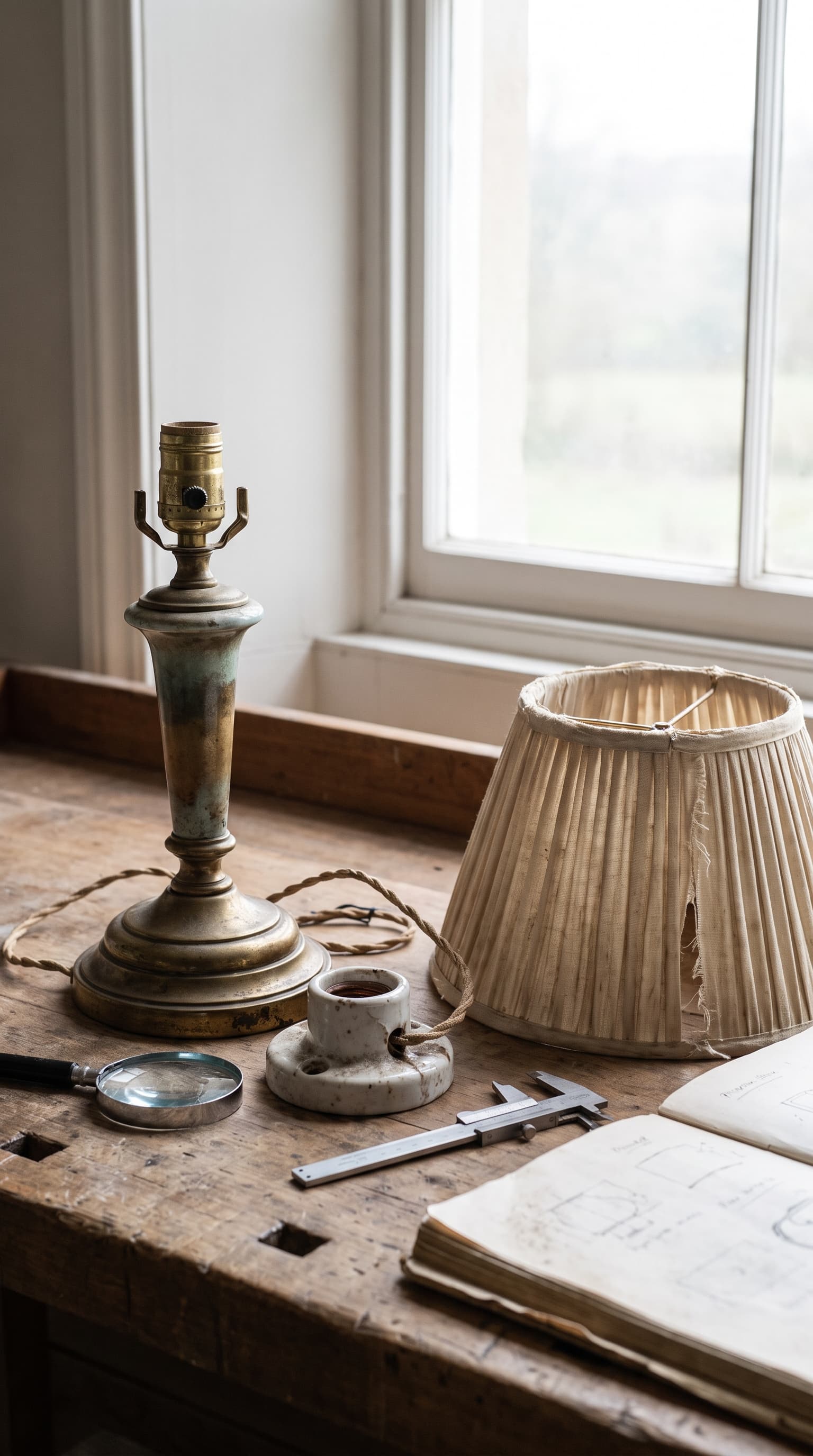
Identifying vintage lamps starts with understanding that a lamp is really three separate components—base, socket assembly, and shade—that evolved on different timelines. A brass base from 1920 might wear a rewired socket from 1975 and a reproduction shade from last year. Knowing which clues belong to which part helps you identify what you actually own.
This guide walks through the physical details that matter most, the photos that capture them clearly, and the common mix-ups that send identifications sideways.
What Clues Matter When You Identify Vintage Lamps
Start with the base. Material and construction tell you more than style alone. Cast iron bases with japanned finishes point to late 1800s–1920s oil-to-electric conversions. Pottery bases with mold seams and glaze pooling suggest American art pottery studios from the 1920s–40s. Sleek aluminum or chrome bases with Bakelite details fit postwar modern production.
Look at how the base was made. Hand-thrown ceramic bases show throwing rings inside. Cast metal bases have seam lines and sometimes sand pitting. Molded plastic bases from the 1950s onward often have maker codes or patent numbers on the bottom.
The socket assembly holds critical dating clues. Pre-1920 sockets used porcelain or brass with exposed screw terminals. Push-through sockets with phenolic (early plastic) bodies became standard in the 1920s–30s. Three-way sockets didn't appear until the late 1940s. Polarized plugs with one blade wider than the other date to post-1960s safety standards.
Socket markings matter. Lamp maker marks stamped into the socket shell or printed on interior cards can identify manufacturers and narrow production windows. Underwriters Laboratories (UL) marks with date codes confirm when the electrical components were approved, though not necessarily when the lamp was assembled.
Wiring gives away age quickly. Cloth-covered twisted cord was standard through the 1950s. Plastic zip cord took over in the 1960s. If the wiring looks new, the lamp may still be old—it just means someone prioritized safety.
Shade attachment methods changed over time. Early oil lamp conversions used flared glass chimneys or simple wire shade holders. Uno fitters (shade sits on the bulb) became common in the 1920s. Harp-and-finial systems dominated mid-century production. Clip-on shades were popular for small accent lamps from the 1950s onward.
Shade materials help too. Mica panels in hammered copper frames point to Arts and Crafts era. Fiberglass shades in atomic shapes scream 1950s. Tiffany-style leaded glass could be authentic Tiffany Studios (rare, valuable) or one of thousands of reproductions made from the 1970s to today.
What Photos to Take for Lamp Identification
Good lamp photos isolate each component so the details don't blur together.
Start with the base. Photograph it from multiple angles in even lighting. Capture the bottom fully—that's where maker marks, model numbers, and material clues live. If there's a felt pad, gently lift one corner to check underneath. Use a flashlight at an angle to reveal embossed or incised marks that disappear in flat light.
Photograph the socket assembly separately. Unscrew the shade and harp if present. Shoot straight-on so any stampings or labels are legible. If there's a small tag or card inside the socket shell, photograph it without removing it—pulling old paper often destroys it. Check the switch mechanism; its style can help date the lamp. How to photograph maker marks applies to socket details just as much as ceramic backstamps.
Capture the plug and cord. A close-up of the plug shows whether it's polarized and original. The cord texture and color can confirm whether the lamp has been rewired.
Document the shade attachment. Show how the shade connects to the lamp—uno fitter, harp, clip, or something else. This detail gets overlooked but often determines whether a shade is original to the base.
Photograph the shade separately. If it's glass, capture the rim, any signatures, and the interior construction. For fabric shades, show the frame and any labels sewn into the lining. Leaded glass shades need close-ups of the leading and glass texture to distinguish studio work from mass production.
Include scale. Place a coin or ruler beside the base and shade. Lamp proportions help confirm whether components belong together.
Common Misidentifications in Vintage Lamps
Assuming all ornate glass shades are Tiffany
- •The confusion: Colorful leaded glass shades often get called "Tiffany" regardless of origin
- •The reality: Tiffany Studios marked most shades. Thousands of companies made similar styles. Unmarked slag glass shades from the 1970s repro boom outnumber originals by huge margins
Treating rewired lamps as worthless
- •The confusion: Collectors sometimes dismiss any lamp with new wiring as "not original"
- •The reality: Rewiring is a safety upgrade and doesn't erase the lamp's age or maker. The base, socket shell, and shade can still be fully authentic and valuable. Original dangerous wiring isn't a virtue
Calling every brass lamp "Victorian"
- •The confusion: Ornate brass bases get lumped into the Victorian era by default
- •The reality: Brass lamp production continued from the 1880s through the 1980s in changing styles. Revival pieces from the 1970s mimic Victorian forms but lack period construction clues
Mixing up oil conversions and electric originals
- •The confusion: Early electric lamps and converted oil lamps look similar from across the room
- •The reality: Oil conversions often show lamp burner threads, font (oil reservoir) seams, and added electrical parts. Purpose-built electric lamps have integrated sockets and bases designed around wiring channels
Ignoring shade-base mismatches
- •The confusion: Whatever shade is on the lamp must belong there
- •The reality: Shades get swapped constantly. A 1920s pottery base might wear a 1980s replacement shade. Check whether the shade's fitter matches the socket, and whether the scale and style make sense together
What Tocuro Helps Resolve in Lamp Identification
Lamp identification often requires comparing your piece to thousands of production variations across a century of lighting history. Tocuro's image recognition analyzes base materials, socket hardware, shade construction, and visible marks to narrow possibilities quickly.
Upload photos of the base, socket, and shade separately. Tocuro identifies each component and flags whether they likely belong together. If your lamp shows mixed-era parts—say, a 1930s art deco base with a 1970s plastic shade—you'll know which piece holds the value.
Tocuro also provides estimated value ranges based on current market signals, though this is not a formal appraisal. Knowing whether your lamp falls into the $30 flea market range or the $300 collector range helps you decide whether to research further or sell as-is.
Example Tocuro-identified item
See this Tocuro public object page for a Chinoiserie Blanc de Chine table lamp by Seyei with identification details, valuation context, and an eBay listing link.
Get Your Lamp Identified Today
Stop guessing whether your lamp is a period piece or a clever reproduction. Identify your lamp with Tocuro's photo-based identification and get clear answers about age, maker, and market value. Upload your photos and see what you actually own.
Photo identification
Identify Your Lamp
Use Tocuro to identify your item from a photo and get an estimated value range when market data is available.