
How to Become a Collector: 10 Rules from Someone Who's Learning Alongside You
Collecting isn't about expertise—it's about passion, curiosity, and creating your own rules. Budget awareness, DIY skills, and relationship-building are your advantages in the market. Buy what you love and don’t over think it.
How to Become a Collector: 10 Rules from Someone Who's Learning Alongside You
Why I'm Writing This
I'm not an expert. I'm a collector who's learning as I go, making mistakes, discovering what works, and figuring out my own taste along the way.
I've been collecting with intention for about a year now—at least 50 estate sales and around five proper antique fairs and shows. These ten rules aren't handed down from some authority—they're what I've learned in the trenches.
If you're starting out or feeling overwhelmed by the collecting world, these principles have helped me move with confidence and less anxiety.
Rule 1: Create Your Own Rules
There's no single "correct" way to collect. What matters is that your approach works for you, your space, your budget, and your joy.
Some collectors focus on a single maker or era. Others are magpies who grab anything that sparks delight. Both are valid. Start by asking yourself what excites you, then build from there.
Rule 2: Know Your Budget (And Your Comfort Zones)
Have a clear sense of your purchasing power. Know what's a splurge versus what's pocket change you don't have to think about twice.
Understanding your budget zones helps you move faster and stay present:
- •Carefree Range — Items you can purchase impulsively without stress or second-guessing
- •Considered Range — Pieces that require evaluation, comparison shopping, or negotiation
- •Splurge Territory — Major acquisitions that need research, sleep-on-it time, and clear intent
Here's the mistake I see collectors make: sitting there with something under $30 that you know you like, wondering if it should really be five dollars less. Getting too caught up on price versus value pulls you out of the moment. Know your zones, and you'll collect with more ease.
Rule 3: Build Great Relationships (With People and Places)
Relationships are your advantage in collecting. The best one is with a dealer or seller who specializes in a category you love.
For me, that's mid-century modern. Taking time to get to know someone, doing repeat business, and letting them know what you're interested in can put you first in line when something special arrives. Often, they'll come straight to you before listing it publicly.
Become a regular at specific shops, fairs, or estate sale companies. People remember collectors who are serious, polite, and genuinely interested.
Rule 4: Get Comfortable with DIY and Cleaning
If you're focused on thrift finds, flea markets, garage sales, and estate sales, you need to evaluate condition and cleanliness before bringing anything home.
Be very careful with upholstered items—bedbugs are a real risk. I have in-laws in Arizona who are collectors. They brought home a chair from an estate sale and ended up with a bedbug outbreak. It's a nightmare scenario that's completely avoidable with proper inspection and sanitization before you bring it .
Investing a little time watching YouTube videos on cleaning brass, polishing silver, restoring wood, and sanitizing textiles will save you trouble later.
DIY skills expand what you can buy confidently. That slightly tarnished lamp or scuffed table becomes a possibility instead of a pass.
Rule 5: Find the Experts in Your Area
I've never met a lamp I didn't love. Often the most interesting lamps don't work or have unsafe wiring. Thankfully, right around the corner is a genius named Yuri at Yuri's Lighting who has rewired, fixed, and saved a variety of pieces for me.
Yuri has restored five lamps for me so far. The cost has ranged dramatically depending on what was needed—anything from under $50 for basic repair work that prevented me from getting an electrical shock or burning down my house, to upwards of $100 for essentially restoring the full working operation of a lamp, including a new shade. The thing about lamps to remember is these are things that really can last decades, and the investment is absolutely worth it.
Take time to identify local experts:
- •Lamp rewiring specialists
- •Upholstery restoration
- •Furniture refinishing
- •Silver and metal polishing
- •Textile repair
Many vendors are comfortable giving ballpark estimates from photos. When you're out collecting and see something you love at a great price but it needs professional work, already knowing what restoration could cost helps you make informed decisions.
Not to mention, these craftspeople are exceptionally talented. Getting the chance to learn even a little of their craft is rewarding.
Rule 6: Keep Key Measurements on Your Phone
If you're collecting to furnish a home, save some basic measurements on your phone. You don't need blueprints, but knowing the dimensions of your couch, bed, or dining table helps immensely when evaluating pieces in the wild.
Here's my philosophy: everything can fit. Thankfully, I've never bought anything that didn't fit, and that's actually my point. It's more about not passing up something great because you don't know if it will fit or you think it won't fit. Having measurements eliminates that excuse.
It's the difference between "I think this might fit" and "I know this will work perfectly."
Rule 7: Loving Something Is the Only Reason You Need to Buy It
It's normal to see something, love it, and immediately think, "But where will I put this?"
That question eliminates some of the best discoveries and joy collecting offers. What I've seen is that when you love something, you'll find a place for it. If you truly have no room, you'll find something you love less and make space. If you need to sell something, even better—you're essentially paying for what you just purchased.
Play the long game. Always.
Rule 8: Don't Get Stuck in One Style, Period, or Genre
Buy what you love. Don't limit yourself by asking if something matches everything else you already own.
The biggest change I ever saw in my own style was Bordallo Pinheiro cabbage pottery ceramics. I always gravitated toward pieces that were more clean, more modern. Anything that verged toward grandma or too traditional, I stayed away from. But on a total whim, I saw these online, and because the color at least fit with the splatterware I had already purchased and fallen in love with, I said, "Okay, let's try it."
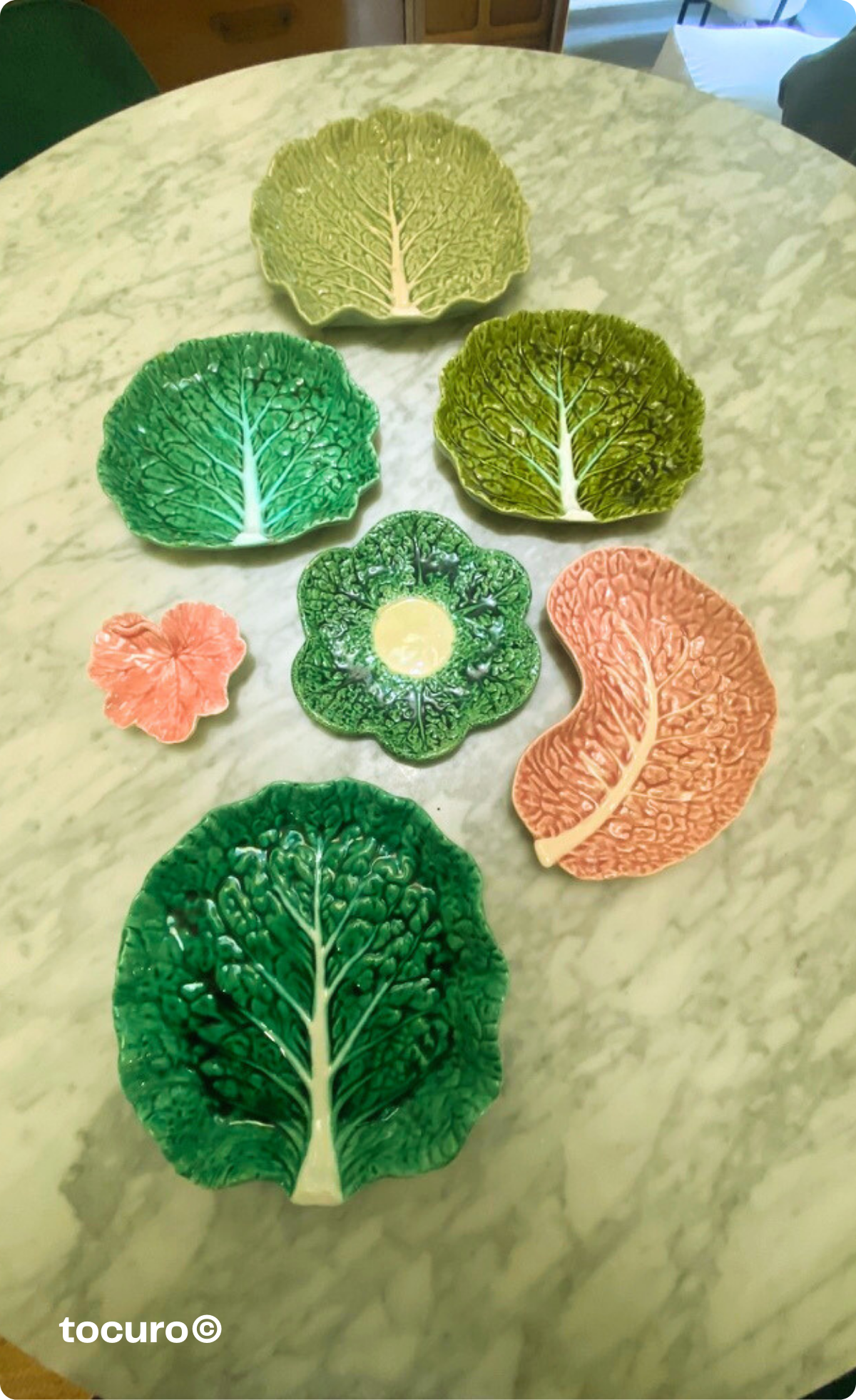
Wall display of Bordallo Pinheiro cabbage dishes and plates, showcasing Portuguese ceramic pottery arranged as a decorative collection.
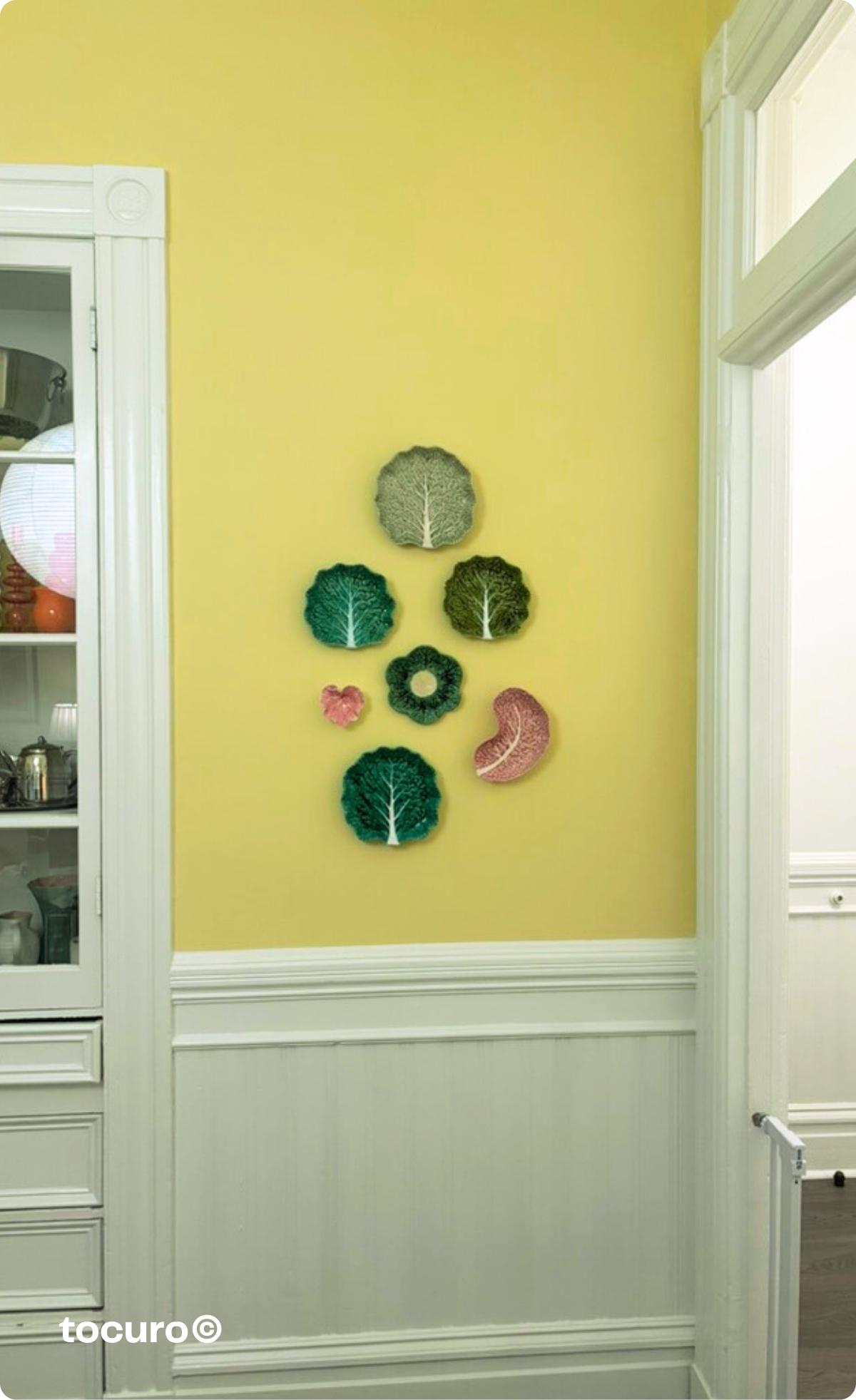
Vintage Bordallo Pinheiro cabbage plates styled on a kitchen wall, highlighting collectible Portuguese pottery in everyday use.
In the end, that opened up a totally new world. Having splatterware—which feels very contemporary, almost timeless and fun—alongside these very classic, more traditional Portuguese cabbage dishes creates an even stronger connection. And here's the kicker: I started seeing these cabbage dishes sold at Zara Home in the primary market, which shows you they're actually totally on trend.
Don't stick to one lane. It's not about restricting yourself. When you see something you're gravitating toward and you try to connect it back to a bigger picture or bigger purpose, that's how you end up blocking yourself from discovery.
Rule 9: Ask Questions (And Use Tocuro to Back You Up)
The most powerful use of Tocuro is to identify a piece with the app, then ask the dealer or seller for their information. It's incredibly validating to see the app match what the dealer says and start a conversation from there.
But there will always be details, nuances, and stories that can only come from a human. The knowledge of dealers and sellers is amazing because it's all based on passion.
Even at estate sales where you don't have an experienced domain expert, learning about the prior owner or residence can tip you off to special elements of the things you're interested in.
Rule 10: Learn How to Discuss Price and Negotiate Confidently and Respectfully
The environment and place will tell you the biggest clue if negotiating is possible. Fairs, estate sales, markets—these are usually negotiation-friendly. Pricing is emotional, so even in those places, be diplomatic and polite. Never assume the seller is willing to negotiate.
Simple Phrases to Open the Conversation
- •"Are you open to negotiating price?"
- •"Do you accept counter offers on listed prices?"
- •"Are you willing to negotiate if I buy more than one thing?"
The Golden Rule: Never Negotiate Unless You're Serious About Buying
If you can't afford the price, don't buy it. But have a sense of your maximum and be open to meeting the dealer in the middle.
Negotiating a price, getting a reduction, and then saying "I need to think about it" is acceptable, but it's not best form. Better to think about the piece, come back, negotiate directly, and close the sale.
If you already have a price you're willing to pay, say it. Don't beat around the bush—it wastes everyone's time.
The beauty of Tocuro gives you an instant sense of market prices and empowers you to be confident and fair in these conversations.
Bonus Rule: Looking Is as Important as Collecting
Going to estate sales, antique stores, and thrift shops with no intention of buying is just as important as visits when you are buying. You're training your eye and digesting the market.
You might be short on funds, short on time, or simply not in the mood. Even a quick one-minute lap around an antique store you haven't been to before is extremely valuable.
The stories I have aren't about going back to a shop to buy something—they're about going back somewhere and finding it was no longer for sale. I'm really trying to encourage people to collect and live without regret. You can sell a mistake purchase, but you can't buy something that was already sold to someone else.
Seeing inventory, noting pricing, stumbling upon that one piece that sticks in your head a day later—it's all part of the journey. Don't limit yourself with expectations of having to buy something every time. Whether you like what you see or not, you're gaining value.
Final Thought
If you've read this far, these rules are for you. Whether you need to identify what something is, bring clarity to your existing finds, manage a watchlist of items you're looking to acquire, or track your collection's value, Tocuro is part of your personality and life as a collector.
Photo identification
Identify Your Item
Use Tocuro to identify your item from a photo and get an estimated value range when market data is available.