
How to Identify Vintage Jewelry: Hallmarks, Clasps, and Photo ID
Identifying vintage jewelry requires examining specific details like hallmarks, clasp types, construction methods, and materials. This guide shows you which clues matter most and what photos help identify age, maker, and authenticity.
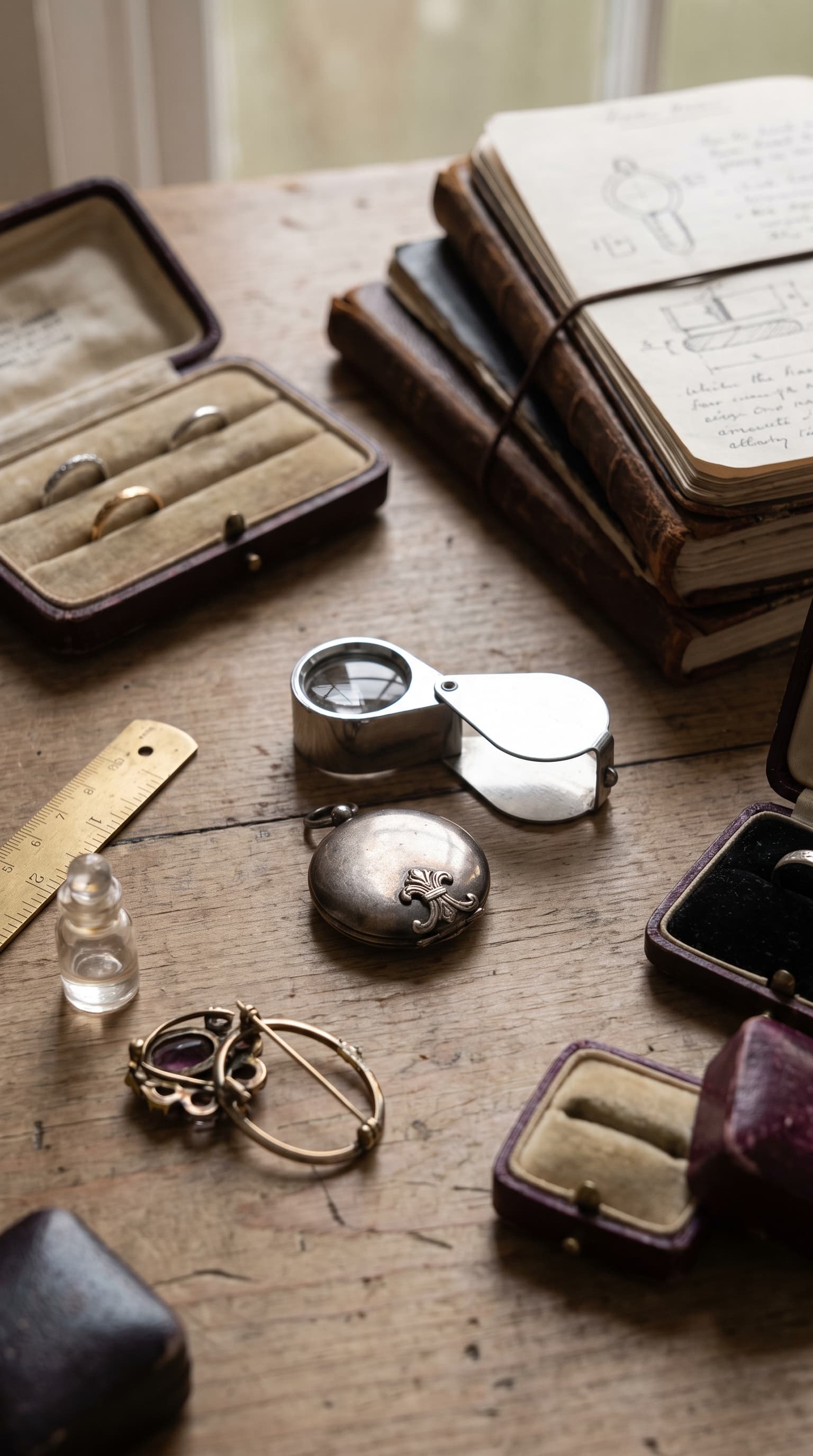
How to Identify Vintage Jewelry: Hallmarks, Clasps, and Photo ID
Identifying vintage jewelry isn't about guessing from a quick glance at a brooch or necklace. The real story lives in tiny hallmarks stamped inside a ring shank, the mechanical style of a clasp, and how a piece was actually constructed. Whether you inherited a box of costume jewelry or found something promising at an estate sale, knowing where to look—and what photos to capture—makes the difference between "pretty old thing" and a documented piece with known origins.
Vintage jewelry spans roughly the 1920s through 1980s, covering Art Deco, Retro, Mid-Century Modern, and beyond. Each era left telltale signs in metal choice, stone settings, and manufacturing techniques. To identify vintage jewelry accurately, you need to examine these details closely, ideally with clear, well-lit photos that capture the evidence.
What Clues Actually Matter When You Identify Vintage Jewelry
Not all details carry equal weight. Here's what experienced collectors check first:
Hallmarks and maker's marks are your strongest leads. These tiny stamps—often inside ring bands, on clasp tongues, or the back of brooches—can tell you the metal content ("925" for sterling, "14K" for gold), country of origin, and sometimes the exact maker. European pieces often carry multiple marks including date letters and assay office symbols. American costume jewelry from makers like Trifari, Eisenberg, or Coro typically shows the company name stamped or in script.
Clasp construction reveals both age and quality tier. Vintage necklaces and bracelets use specific clasp types that changed over decades. Spring ring clasps became common in the 1930s-40s. Fold-over box clasps with safety chains suggest 1940s-60s quality pieces. Costume jewelry from the 1950s-60s often used simple hook-and-eye or barrel clasps. Modern lobster clasps didn't become standard until the 1970s-80s.
Pin backs and findings date brooches and earrings. The C-clasp (a simple curved pin with no roll-over safety) indicates pre-1910 to 1940s manufacturing. Trombone clasps appeared in the 1930s-50s. Screw-back earrings dominated from the 1900s through 1950s, while clip-backs became popular in the 1930s-60s. Modern pierced posts with butterfly backs didn't become standard until the late 1960s-70s.
Stone setting techniques show manufacturing era and quality level. Hand-set prong work with slight irregularities suggests older, handmade pieces. Perfectly uniform channel settings and mass-produced bezels point to later vintage or modern manufacturing. Foil-backed rhinestones in closed settings are typical of costume jewelry through the 1950s, while open-back settings became more common in the 1960s-70s.
Metal patina and wear patterns tell the truth about age. Genuine vintage pieces show wear where they actually made contact—clasp mechanisms, the back of pendants that rested against clothing, ring shanks. Artificially aged pieces often show uniform "antiquing" in places that wouldn't naturally wear. Gold-plated vintage costume jewelry typically shows wear at high points where the base metal shows through.
What Photos Help Identify Vintage Jewelry
The photos you take determine what can be identified. Here's your shot list:
Close-up hallmark photos should be your first priority. Use your phone's macro mode or get as close as your camera allows while maintaining focus. Natural daylight works best—avoid harsh flash that creates glare on metal. Photograph every mark you find: inside rings, on clasp tongues, the back of pendants, pin stems, earring posts. If marks are tiny, try placing the piece on a contrasting background (white paper for dark metal, dark cloth for light metal) and take several shots from slightly different angles.
Clasp and closure details need clear shots from multiple angles. For necklaces and bracelets, photograph the clasp mechanism closed and open. Show how the parts connect. For brooches, capture the entire pin assembly from the side and back. For earrings, get clear shots of the back findings.
Overall construction photos should show how the piece is made. Photograph the back of brooches, pendants, and earrings where you can see how stones are set, how metal is joined, and what materials are used. Close-ups of stone settings, prong work, and any decorative metalwork help establish manufacturing quality and era.
Scale and proportion shots matter for larger pieces. Include a common object (coin, ruler) for size reference. This helps distinguish between jewelry categories—a large brooch versus a smaller pin, a choker versus a longer necklace.
Condition and wear photos document authenticity. Show areas of natural wear, any repairs, missing stones, or damage. These often support rather than detract from a piece's story.
Common Misidentifications in Vintage Jewelry
Certain mistakes happen repeatedly, even among experienced sellers:
"Gold" versus gold-plated or gold-filled causes endless confusion. A piece that looks gold and shows no hallmark is likely plated brass or base metal. Gold-filled pieces are marked "GF" or "1/20 12K" and contain a measurable layer of gold mechanically bonded to base metal—these can have real value. Solid gold always carries karat marks, though very old pieces might show wear that obscures marks.
Rhinestones versus diamonds trips up optimistic finders. Quality vintage rhinestones—especially hand-set Austrian crystals in signed costume pieces—can look remarkably brilliant. True diamonds show different optical properties, need different settings, and appear in pieces with gold or platinum marks, not base metal.
"Antique" versus vintage versus retro gets mixed up constantly. Antique jewelry is pre-1920s (Victorian, Edwardian, Art Nouveau). Vintage typically means 1920s-1980s. "Retro" specifically describes the 1940s era with its chunky, sculptural gold pieces. These distinctions matter for value and accurate identification.
Designer costume jewelry versus unsigned pieces represents a significant value gap. A 1950s Trifari brooch with clear maker's mark can be worth considerably more than a similar-looking unsigned piece. But only if you catch the mark—many sellers miss tiny signatures.
Modern reproductions of vintage styles flood the market, especially "Art Deco style" and "Victorian style" pieces from recent decades. These often use modern findings (lobster clasps, modern posts), show no patina or wear, and feature overly perfect, machine-made construction. The style looks old, but the evidence says otherwise.
What Tocuro Helps Resolve
Some jewelry identification questions need expert eyes, especially when hallmarks are partial, worn, or use unfamiliar symbols. Tocuro helps you identify vintage jewelry from photos by analyzing the visual evidence you capture—those hallmarks, clasps, construction details, and style elements that collectively point toward age, maker, and type.
Upload clear photos showing your piece's marks, clasp mechanisms, and overall construction. Tocuro's identification system examines these details and provides context about what you have, including estimated value ranges based on current market signals. This is particularly useful when you're sorting inherited jewelry, evaluating estate sale finds, or deciding whether a piece warrants further authentication.
You get 7 free identifications per day, with your count resetting daily—helpful when you're working through a jewelry box with multiple pieces. The process focuses on practical identification: what the piece likely is, when it was probably made, and what similar examples are selling for, based on the photographic evidence you provide.
Ready to Identify Your Vintage Jewelry?
Gather your pieces, find good lighting, and start photographing those hallmarks and clasps. The details you capture tell the real story—often more than you expected. When you need expert help interpreting what you're seeing, identify your vintage jewelry with photos that show the evidence. Sometimes that mysterious brooch has a maker's signature hiding right on the pin stem, and knowing what you have changes everything.
Photo identification
Identify Your Jewelry
Use Tocuro to identify your item from a photo and get an estimated value range when market data is available.