
How to Price Vintage Furniture for Sale: A Collector's Guide to Setting the Right Value
Pricing vintage furniture accurately starts with understanding what you have, checking condition quickly, and researching comparable sales. This guide walks you through the practical steps collectors use to set fair prices before listing pieces for sale.

How to Price Vintage Furniture for Sale: A Collector's Guide to Setting the Right Value
You've decided to sell a vintage sideboard, a mid-century chair, or maybe that oak dresser that's been in the family for decades. The hardest part isn't finding a buyer—it's knowing what to ask. Price too high and it sits. Price too low and you leave money on the table. How do you find that sweet spot when you're not a professional dealer?
Pricing vintage furniture for sale comes down to three things: knowing what you actually have, understanding its condition honestly, and checking what similar pieces are selling for right now. This guide gives you a practical framework to price your vintage furniture confidently, whether you're selling one piece or clearing out an estate.
The Pre-Pricing Reality Check: What Are You Actually Selling?
Before you research prices, you need to know what you're pricing. "Vintage dresser" tells you almost nothing. A 1950s Lane cedar chest prices differently than a 1920s oak highboy, even if both are "old dressers."
Start by identifying these basics:
Style and era. Is it mid-century modern? Art Deco? Colonial Revival? The style affects value significantly. A Heywood-Wakefield dresser from 1955 commands different prices than a 1955 no-name bedroom set.
Construction clues. Look at joints (dovetails usually indicate quality), hardware (original pulls add value), and wood type (solid walnut beats veneer over particleboard). These details matter to buyers and directly impact what you can ask.
Maker or manufacturer. Check drawers, backs, and undersides for labels, stamps, or tags. Signed pieces from known makers (Herman Miller, Knoll, Stickley, Lane) typically bring higher prices than unsigned furniture of similar age and style.
If you're not sure what you have, don't guess. Most pricing mistakes start here—calling something "antique" when it's vintage, or missing a maker's mark that doubles the value.
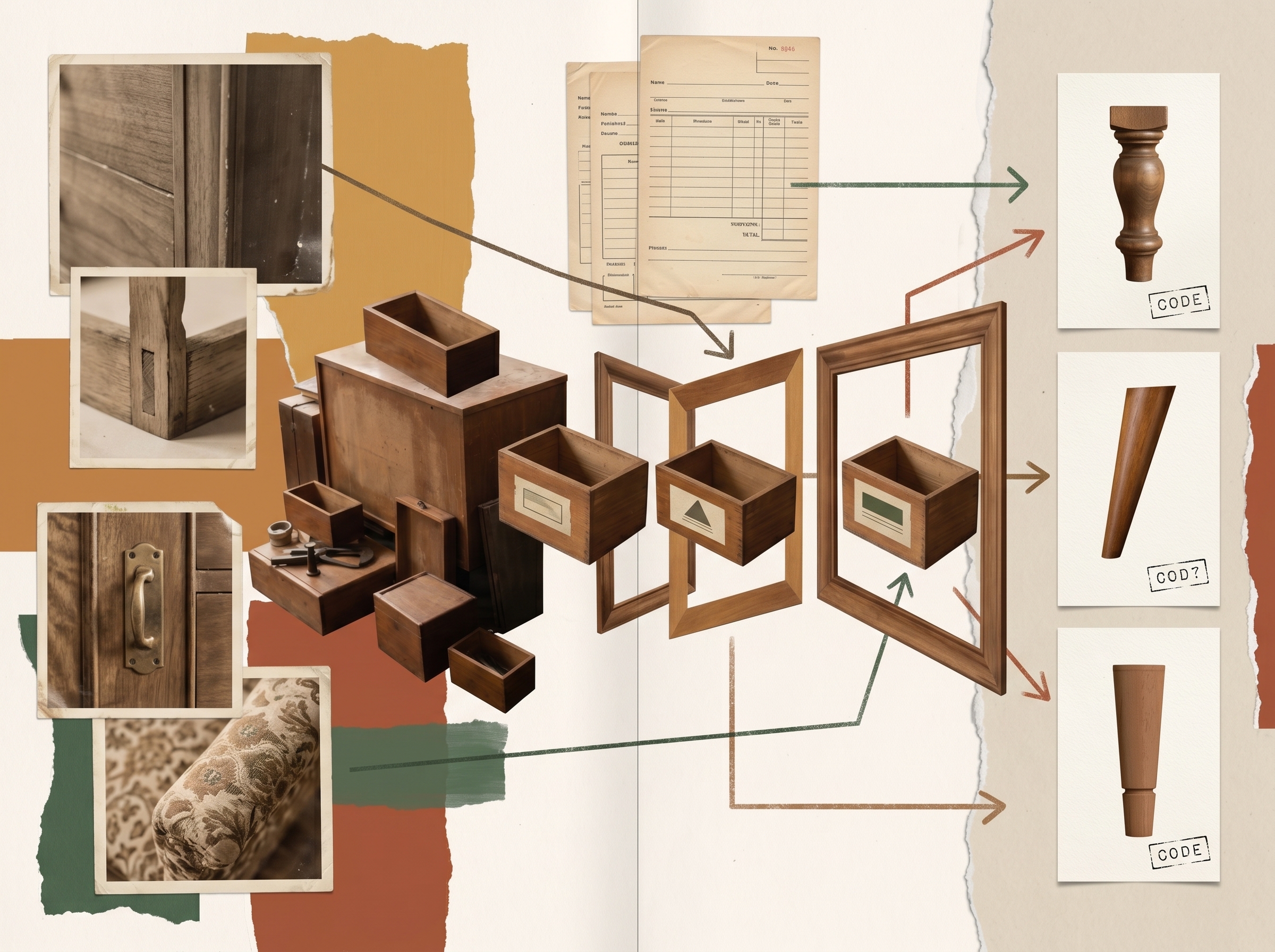
How to Price Vintage Furniture: Quick Condition Assessment
Condition determines whether your piece sells at the high or low end of its range. Be honest with yourself—buyers will see flaws in person or ask detailed questions before committing.
Surface issues. Note scratches, water rings, finish wear, and sun fading. Light wear is expected and often priced in. Deep scratches, major discoloration, or missing veneer require price adjustments.
Structural soundness. Open every drawer, sit in every chair, test every hinge. Wobbly legs, stuck drawers, broken supports, or loose joints lower value unless you're marketing to someone who refinishes furniture.
Original vs. altered. Has it been refinished? Repainted? Are the pulls original? Buyers often pay more for original finish and hardware, even with some wear, than for poorly refinished pieces.
Completeness. Missing shelves, replaced glass, added casters, or cut-down legs all affect price. Note what's missing or changed.
Write this down. When you start researching comparable sales, you'll need to compare apples to apples—matching condition to condition.
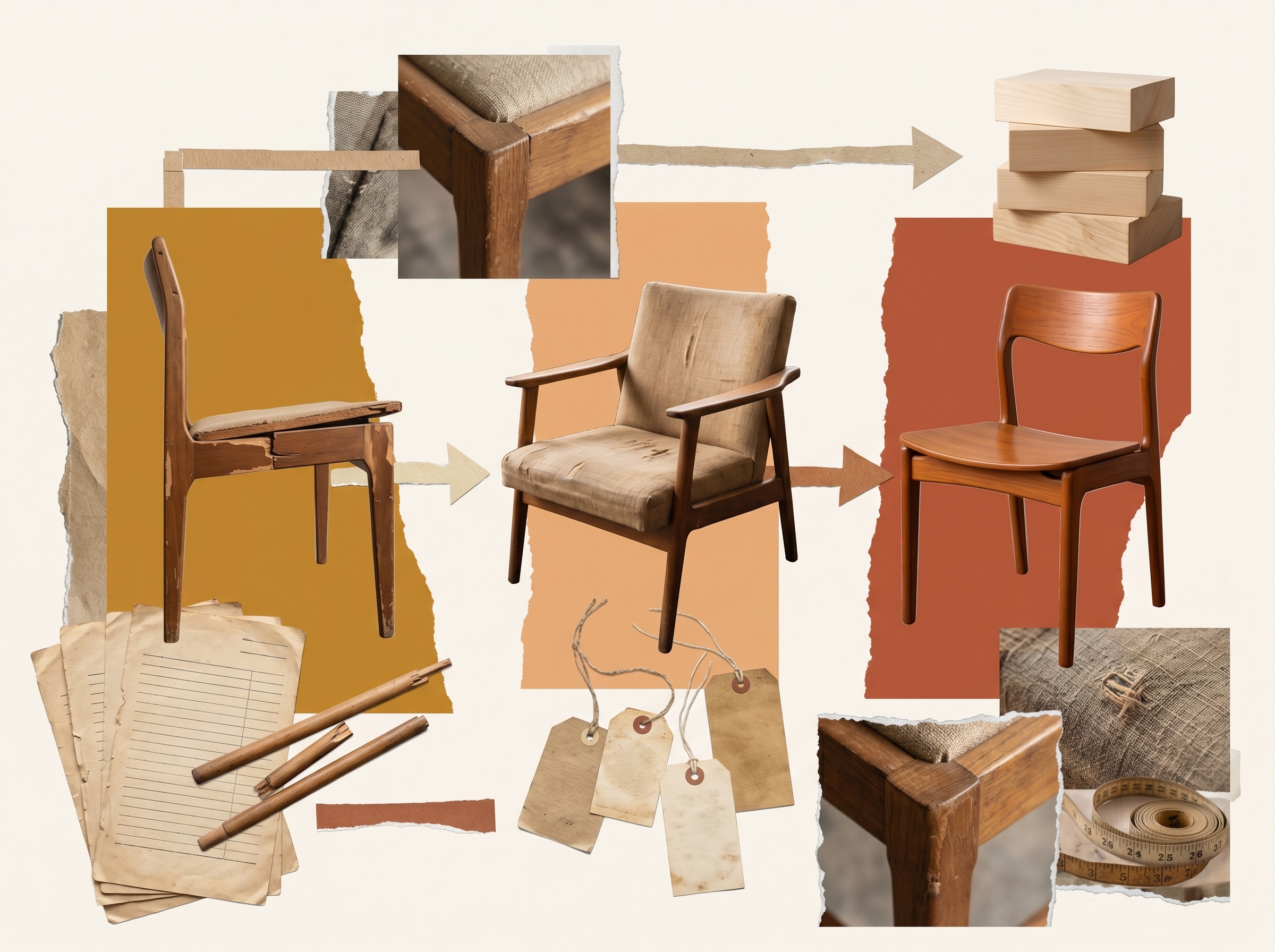
What's Worth Deep Research vs. Quick Comps
Not every piece needs hours of research. Some vintage furniture has clear, consistent pricing. Other pieces require more digging.
Straightforward to price
- •Mass-produced mid-century pieces from known makers with consistent secondary markets (Lane, Bassett, Thomasville)
- •Common styles with lots of recent sales data (1960s dressers, 1970s dining sets)
- •Generic vintage without special provenance or maker attribution
For these, you can often find multiple sold listings in minutes and average out a fair range.
Worth extra research
- •Designer or high-end maker pieces where attribution affects value significantly
- •Unusual forms or rare styles where you won't find many direct comparisons
- •Pieces in exceptional original condition that might command collector premiums
- •Furniture with maker's marks you can't identify without help
These pieces benefit from proper identification before pricing. Misidentifying a reproduction as an original, or missing a valuable maker's mark, can cost you hundreds or thousands of dollars.
Where to Find Real Market Prices
Once you know what you have and its condition, research comparable sales. Not asking prices—sold prices.
eBay sold listings. Search your item, then filter by "Sold" to see what buyers actually paid. Look for pieces similar in style, era, condition, and size. Note regional differences—some styles sell better in certain areas.
Etsy and Chairish sold data. Etsy shows "bestsellers" in vintage categories, and Chairish sometimes displays sale prices for similar items. These platforms skew toward design-conscious buyers willing to pay for style and condition.
Local Facebook Marketplace and Craigslist. Check your region for recently sold or listed prices. Local market matters—mid-century modern sells faster in urban areas, while traditional oak furniture may do better in smaller towns.
Auction results. For higher-end or unusual pieces, search auction house results (LiveAuctioneers, Invaluable). Remember auction prices often include buyer's premiums, so adjust accordingly.
Look at 5–10 comparable sales, not just one. Outliers happen. You want the realistic middle range where most transactions occur.
How to Actually Set Your Price
Now that you've done the research, here's how to translate it into your asking price.
Calculate your range. Based on sold comps, note the low, middle, and high prices for similar condition pieces. Your price should fall somewhere in this range depending on your urgency and local market.
Adjust for your specifics. If your piece has better original hardware, cleaner finish, or documented provenance, lean toward the higher end. If it needs work, price at the lower end or below.
Factor in your selling method. You can ask more on platforms where buyers expect curated, quality pieces (Etsy, Chairish, 1stDibs) than on Facebook Marketplace or a garage sale. Where you sell affects pricing strategy.
Leave negotiation room. Most buyers expect some flexibility. If your research says $400–600 and you want $500, list at $550–575 and be willing to come down slightly.
Be ready to justify it. When someone asks why you're asking $800, you should be able to explain: "This is a 1958 Lane Acclaim dovetail dresser with original finish and hardware. Recent sold comps range from $750–900 depending on condition."
Using Photo-Based Tools to Speed Up Pricing
Identifying and pricing vintage furniture used to mean hours of research, reference books, and guesswork. Now you can start with a photo.
Tocuro identifies furniture from photos and provides estimated value ranges based on real market signals—not formal appraisals, but solid starting points grounded in actual sales data. Upload a few clear pictures showing the whole piece, any labels or marks, and construction details, and you'll get an identification and value range in seconds.
This works especially well when you're not sure what you have, when you're pricing multiple pieces quickly, or when you need a reality check on whether your heirloom dresser is worth $200 or $2,000. You get 7 free identifications per day, and the count resets daily, so you can price multiple items without committing to paid tools upfront.
Think of it as your first step—get a baseline identification and value range, then dive deeper into sold comps for pieces at the higher end of your collection. For more guidance on the complete selling process, check out how to sell antique furniture for the best price.
Common Pricing Mistakes to Avoid
Even experienced sellers make these errors:
Pricing based on what you paid or sentimental value. The market doesn't care what you paid in 1995 or that it was Grandma's. Price on current market comps.
Confusing asking prices with sold prices. Someone listing a Lane cedar chest for $900 doesn't mean it's worth $900. Check if it actually sold.
Ignoring condition honestly. "Good vintage condition" still means scratches and wear to most buyers. Don't overprice based on wishful thinking about condition.
Not adjusting for local markets. A Saarinen tulip table sells faster in Brooklyn than rural Montana. Price for your actual buyer pool.
Setting one price forever. If your piece hasn't sold in 3–4 weeks and you're getting no interest, the market is telling you something. Reevaluate.
Ready to Price Your Pieces?
Pricing vintage furniture combines detective work, market research, and honest assessment. Start by identifying exactly what you have, check its condition realistically, research comparable sold prices, and set your asking price with room to negotiate.
When you need a fast identification and baseline value range to start your pricing research, use Tocuro to identify your furniture from photos. Upload clear images, get your estimated range, then refine your price using sold comps in your local market. Whether you're selling one piece or an entire estate, smart pricing starts with knowing exactly what you have.
For more detailed guidance on listing and selling your pieces effectively, see our guide to selling vintage furniture online.
Photo identification
Identify Your Item
Use Tocuro to identify your item from a photo and get an estimated value range when market data is available.